In a major crackdown on cybercrime, Jharsuguda Police on Monday busted an organised network allegedly involved in creating and supplying mule bank accounts to cybercriminals operating across India

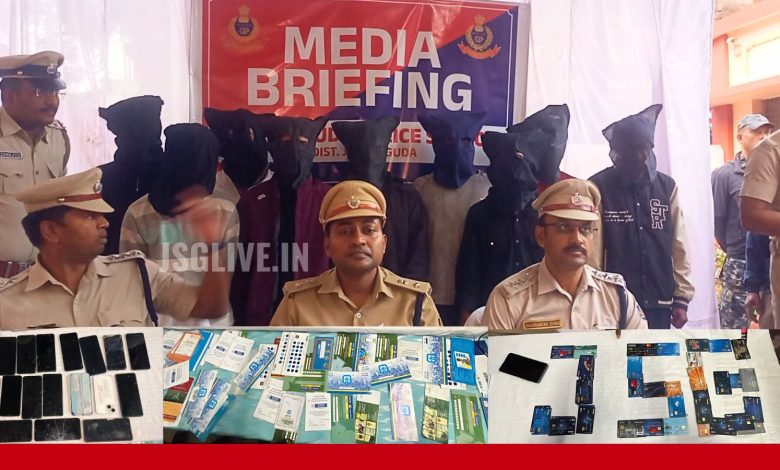
Jharsuguda: In a major crackdown on cyber fraud, Jharsuguda Police on Tuesday, under Operation Netra, have unearthed a widespread racket using mule bank accounts to commit financial scams across states. Police have nabbed 10 people,and detained two juveniles, and frozen Rs. 16 lakh linked to fraudulent transactions. Those arrested include individuals from Jharsuguda, Sambalpur, and Rourkela.
Police identified the accused as Abhiraj Kumar Sah (26), a resident Rourkela, Sundargarh and also a native of Bihar an the main aaccused behind this racket, Sonu Mandal (23), Subham Prasad (21), Shiwan Sahu (20), Abhay Ghosh (20), Samir Suna (20), M. Jagadishwar Rao (19), all residents of Jharsuguda, Jogeswar Chand (24), Naresh Bag (25), Dhiraj Gardia (20) all three resident of Bateimura Village of Sambalpur District and two CICL (Children in Conflict with Law).
Police have seized 61 bank passbooks of various banks, 41 ATM cards, 19 mobile phones with SIM cards, A Maruti Swift Dzire (OD23 R 9266), and A Honda Activa scooter (OD 23 Q 5619). Police officials also confirmed that around Rs. 16 Lakhs in multiple accounts was identified as fraud-linked and subsequently frozen to prevent further misuse.
Jharsuguda SP G.R. Raghavendra Said, “It is an organised crime, the accused lured locals, mostly youth and daily wage earners, by offering cash to open new bank accounts. After collecting the full banking kit, ATM card, passbook and net banking access, the details were handed over to cybercrime syndicates operating in larger cities. These mule accounts were then used to route money from online scams, withdrawals were made quickly, and the funds were transferred further to disguise the trail. The investigation is underway to trace the higher-level operators and financial handlers involved in the racket.”
He also warned the public not to hand over bank accounts or credentials to strangers in exchange for cash incentives. “Such activities directly assist cyber fraud and can result in serious legal action,” he added